All posts · Prop firms · Risk management · Expert Advisors
The Most Important Prop Firm Rules (and How Traders Break Them)
Learn the key prop firm rules on drawdown, daily losses, consistency, news trading, and payouts—and how traders accidentally break them.
· 9 min read
Prop firm rules can determine whether a trader passes an evaluation, keeps a funded account, or qualifies for a payout. Even a trader who makes profitable trades can run into trouble by misunderstanding a loss limit, trading during a restricted news event, or failing to meet a firm's conditions.
A proprietary trading firm, commonly called a prop firm, offers traders access to a trading programme under specific conditions. Many retail prop firms use an evaluation or challenge to assess trading performance before offering access to a funded account or a simulated account with performance-based payouts. The exact arrangement depends on the provider.
The challenge is that there is no single rulebook shared by every prop firm. One programme may use a trailing drawdown, while another uses a fixed limit. A firm may restrict trading around major economic announcements, while another permits it under certain conditions. Even different account types at the same firm can have different rules.
Understanding these differences matters before paying an evaluation fee. Here are the most important prop firm rules, why they exist, and the mistakes traders should watch out for.
1. Maximum Drawdown Rules
Maximum drawdown is the amount an account can lose before it breaches its permitted loss threshold. It is one of the most important rules to understand because breaching it can lead to an account being closed or an evaluation being failed.
For example, suppose a hypothetical $50,000 account has a maximum drawdown limit of 10%. That represents a $5,000 loss allowance. Depending on the programme's calculation method, the relevant account threshold could be $45,000.
However, the calculation method matters just as much as the percentage.
Static vs. trailing drawdown
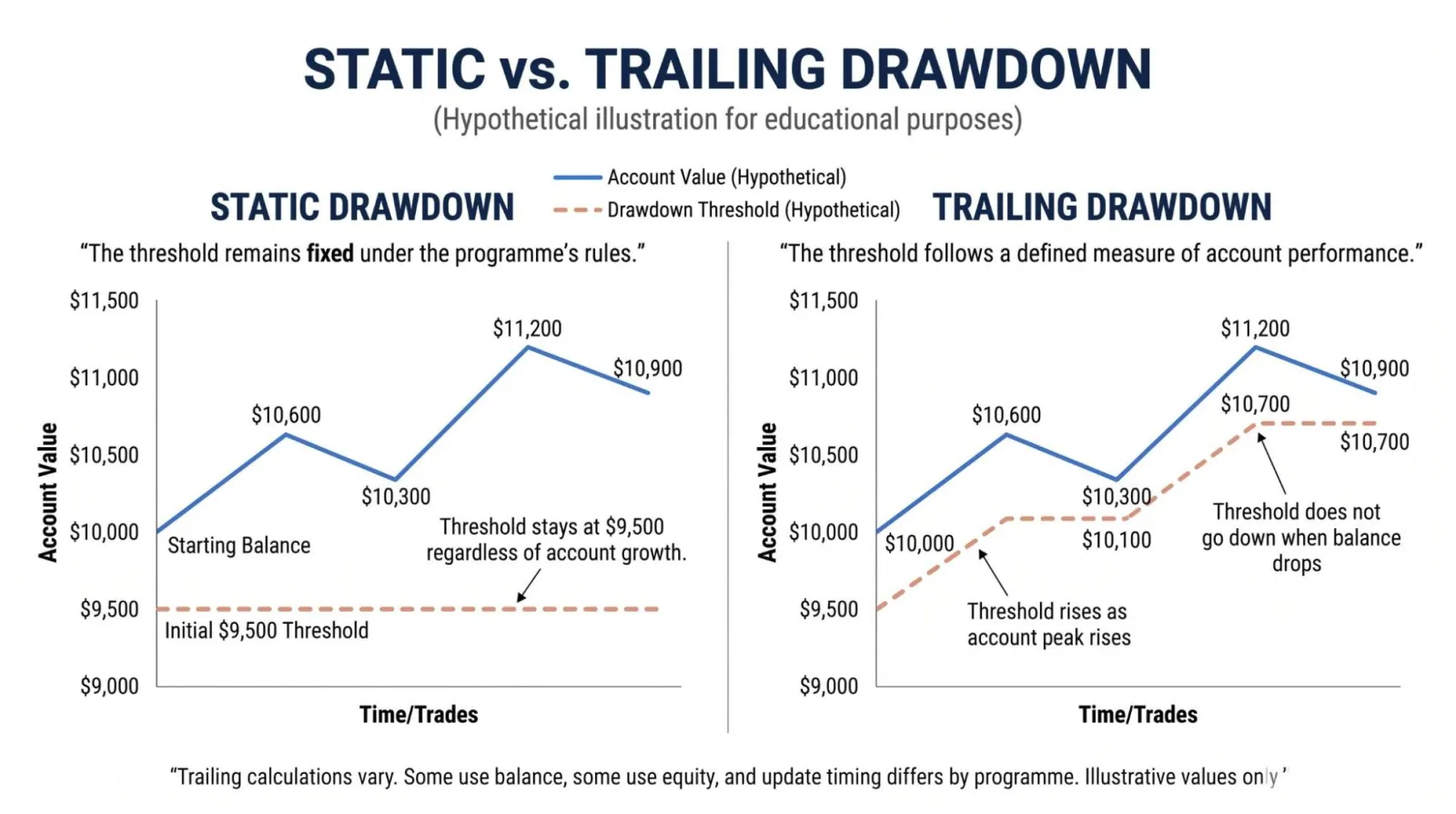
A static drawdown uses a fixed loss threshold based on the programme's rules. The threshold does not rise simply because the trader makes a profit.
A trailing drawdown moves according to a defined measure of account performance, such as the highest balance or equity reached. Depending on the programme, it may update during the trading day or only at a specified time.
This creates an important difference. A trader using a trailing-drawdown account might build up profits, causing the permitted loss threshold to move upward. If the trader later gives back those gains, the account could breach its threshold even if its balance remains above the original starting balance.
The exact calculation depends on whether the firm uses balance or equity, realised or unrealised profit, and intraday or end-of-day updates. These details must be checked in the applicable rules.
How traders break drawdown rules
A common mistake is assuming that a profitable trade gives them more room to take risks. Another is monitoring only the account balance while ignoring open positions and floating losses.
For example, a trader may see a $50,000 account rise to $51,000 and assume that the entire $6,000 difference between the new balance and a $45,000 threshold remains available. But if the firm's trailing threshold has moved upward with the account's peak performance, that assumption could be wrong.
How to avoid it: Identify the exact drawdown method, the threshold calculation, and whether open trades count toward the limit. Monitor the account's actual breach level rather than relying on the original account size alone.
2. Daily Loss Limits
A daily loss limit restricts how much an account can lose within a defined trading day. It is different from maximum drawdown, which usually covers a wider period or the account's overall permitted loss.
Imagine a hypothetical programme with a $50,000 starting balance and a daily loss limit of 5%. If the firm's rules calculate the limit from the initial balance, the daily allowance would be $2,500. The actual calculation may differ if the programme uses a changing balance, equity, or another reference point.
The firm's definition of a trading day also matters. Its daily reset may follow a particular server time or market session rather than the trader's local midnight.
How traders break daily loss limits
Traders can breach the limit by taking oversized positions, opening several correlated trades, or continuing to trade after early losses.
For example, a trader loses $1,000 in the morning and decides to recover the money quickly. They increase their position size and open multiple trades. If those trades move against them together, the daily loss threshold may be reached before they can close everything.
Another mistake is assuming that only closed losses count. Some programmes calculate losses using equity, which can include unrealised losses on open positions.
How to avoid it: Learn how the daily limit is calculated and when it resets. Set a personal stopping point below the firm's maximum, and account for existing positions before opening new ones. Our guides to position sizing and risk management cover the basics.
3. Profit Targets and Evaluation Requirements
Many prop firm challenges require traders to reach a specified profit target while staying within the programme's loss limits. Some also impose minimum trading days, time limits, or additional requirements before a trader can progress to the next stage.
A profit target alone does not determine whether an evaluation is passed. The trader may need to reach it without breaching another rule.
For example, a hypothetical challenge could require a 10% profit while limiting total drawdown to 5%. A trader who reaches the profit target but breaches the drawdown limit along the way may fail, depending on how the programme evaluates breaches.
How traders break evaluation rules
One common mistake is focusing exclusively on the target. Traders may increase their risk after a slow start, attempt to reach the target in a single session, or continue trading unnecessarily after achieving it.
Others overlook minimum trading-day requirements or assume that reaching the target automatically triggers account approval.
How to avoid it: Read the rules for every evaluation phase. Confirm the profit target, drawdown limits, minimum trading days, time restrictions, and what happens after the target is reached. Avoid assuming that requirements from one phase automatically apply to another.
4. Consistency Rules
Some prop firms use a consistency rule to limit how much of a trader's total profit can come from one particularly profitable day or trade. These rules are intended to assess a more consistent pattern of results, but their formulas and consequences vary by programme.
For example, a hypothetical rule might state that no single trading day can account for more than 40% of the total profit used in a particular calculation. If a trader earns $2,000 on one day and $3,000 in total profit, that day accounts for about 66.7% of the total.
Under that hypothetical rule, the trader would exceed the 40% threshold. Depending on the firm's terms, they might need to generate more qualifying profit before requesting a payout, or the rule might affect their eligibility in another way.
Importantly, not every prop firm has a consistency rule, and a rule may apply to evaluation, funded accounts, payouts, or only particular programmes.
How traders break consistency rules
Traders may discover the rule only after making a large profit in a single session. Others may misunderstand whether the calculation uses gross profit, net profit, the best trading day, or another measure.
Trying to force extra trades simply to change a consistency percentage can create additional risk.
How to avoid it: Check whether a consistency rule applies, how it is calculated, and what happens when the threshold is exceeded. Understand whether it affects passing the evaluation, receiving a payout, or both.
5. News Trading and Weekend Restrictions
Economic announcements can cause rapid price movements, wider spreads, and less predictable execution. As a result, some prop firms restrict trading around certain high-impact news events.
Depending on the programme, a rule might prohibit opening positions shortly before an announcement, closing positions during a restricted window, or holding trades through specified events. Other programmes may permit news trading without those restrictions.
Weekend holding is another potential restriction. Some accounts allow positions to remain open over the weekend, while others require positions to be closed before a specified cutoff.
How traders break these rules
A trader might open a position before a major economic release without realising that the restriction applies to the funded account. Another might leave a trade open on Friday because their strategy normally holds positions for several days.
A further complication is that a firm may treat evaluation and funded accounts differently. Permission to trade an event during a challenge does not necessarily establish permission to do so after funding.
How to avoid it: Check the current news calendar, the firm's definition of restricted events, the exact time window, and its weekend-holding policy. Verify whether the rules differ by instrument, account type, or trading phase.
6. Prohibited Trading Strategies and Automation
Prop firms may restrict certain trading behaviours or methods. Depending on the provider, these can include prohibited forms of arbitrage, exploiting platform errors, coordinated trading between accounts, certain copy-trading arrangements, or unauthorised automated strategies.
The key distinction is that using an Expert Advisor (EA), trading bot, or copy-trading tool is not universally prohibited. Some programmes allow automation, while others impose conditions or prohibit it altogether.
How traders break these rules
A trader might assume that an EA is allowed because the firm permits other automated strategies. Another might copy trades between accounts without checking whether the arrangement meets the firm's requirements.
Traders can also run into trouble when their strategy falls under a prohibited-practice clause they have not read carefully.
How to avoid it: Confirm whether your particular strategy, software, account setup, and execution method are permitted. If a rule is unclear, obtain clarification from the firm's support team before using the method. Do not assume that a strategy is permitted simply because the platform allows it. If you do run an EA, test it on a demo account with the same loss limits first.
7. Minimum Trading Days, Inactivity, and Payout Rules
Passing an evaluation is not always the final step. Depending on the programme, traders may need to satisfy minimum trading-day requirements, remain active within a specified period, complete verification, or meet additional conditions before requesting a payout.
Payout rules can cover the first eligible withdrawal date, the payout cycle, the trader's share of eligible profits, and conditions that must be satisfied before payment. Some programmes also apply consistency requirements or other restrictions at this stage.
How traders break these rules
A trader might reach a profit target but fail to complete the required number of trading days. Another might assume that a payout is immediately available after making a profit, without checking the waiting period or eligibility criteria.
Inactivity rules can cause problems too. A trader who takes a break may overlook a requirement to place a trade within a specified period.
How to avoid it: Review the payout terms before purchasing a challenge. Confirm the minimum trading days, inactivity conditions, withdrawal schedule, verification requirements, and any restrictions that could affect payout eligibility.
How to Check a Prop Firm's Rules Before Paying
Before purchasing an evaluation, read the rules for the exact account or programme you intend to use. A firm's marketing page may summarise the main conditions, but the detailed rulebook or help centre is where you should verify how each requirement works.
Use this checklist:
- Drawdown: Is it static or trailing? Does it use balance, equity, or both?
- Daily losses: What is the limit, how is it calculated, and when does it reset?
- Profit target: What must you achieve in each evaluation phase?
- Consistency: Does a rule apply to profitable days or payout eligibility?
- News and weekends: Can you trade around economic releases or hold positions over weekends?
- Trading methods: Are EAs, copy trading, hedging, and your intended strategy permitted?
- Trading days and inactivity: Are there minimum activity requirements or deadlines?
- Payouts: When can you request a withdrawal, and what conditions must be met?
- Consequences: Does breaking a rule close the account, remove certain profits, pause trading, or delay a payout?
Keep a copy of the applicable rules and note when you checked them. If the firm's documentation is unclear, ask for written clarification before paying. Rules can change, so verify the current terms rather than relying on an old review or another trader's experience.
Final Thoughts
Understanding prop firm rules is part of understanding the programme itself. Drawdown limits, daily loss thresholds, consistency requirements, news restrictions, and payout conditions can all affect a trader's experience, even when their underlying strategy is sound.
The most useful approach is to understand the rules before trading, calculate the relevant limits, and build a process that stays comfortably within them. Avoid increasing risk simply to meet a deadline or recover losses.
Remember that passing a challenge does not guarantee future payouts or trading success. Read the applicable terms carefully, check that the programme suits your trading approach, and never assume that every prop firm operates under the same conditions.
Build a bot from your idea
Describe your trading idea and the AI writes MT4 or MT5 code for you to review and test, with a plain-English explanation and setup steps. Your first bot is free.