All posts · Gold · Macro · Forex
Gold vs. the US Dollar: How They're Connected
Learn why gold and the US dollar often move in opposite directions, how interest rates affect both, and why their relationship can change.
· 9 min read
Gold and the US dollar are two markets that many traders watch closely. Gold is often associated with wealth preservation and uncertainty, while the US dollar plays a major role in global trade and financial markets. Although they serve different purposes, traders watch their prices closely together because changes in the dollar can influence gold, and both can respond to the same economic news.
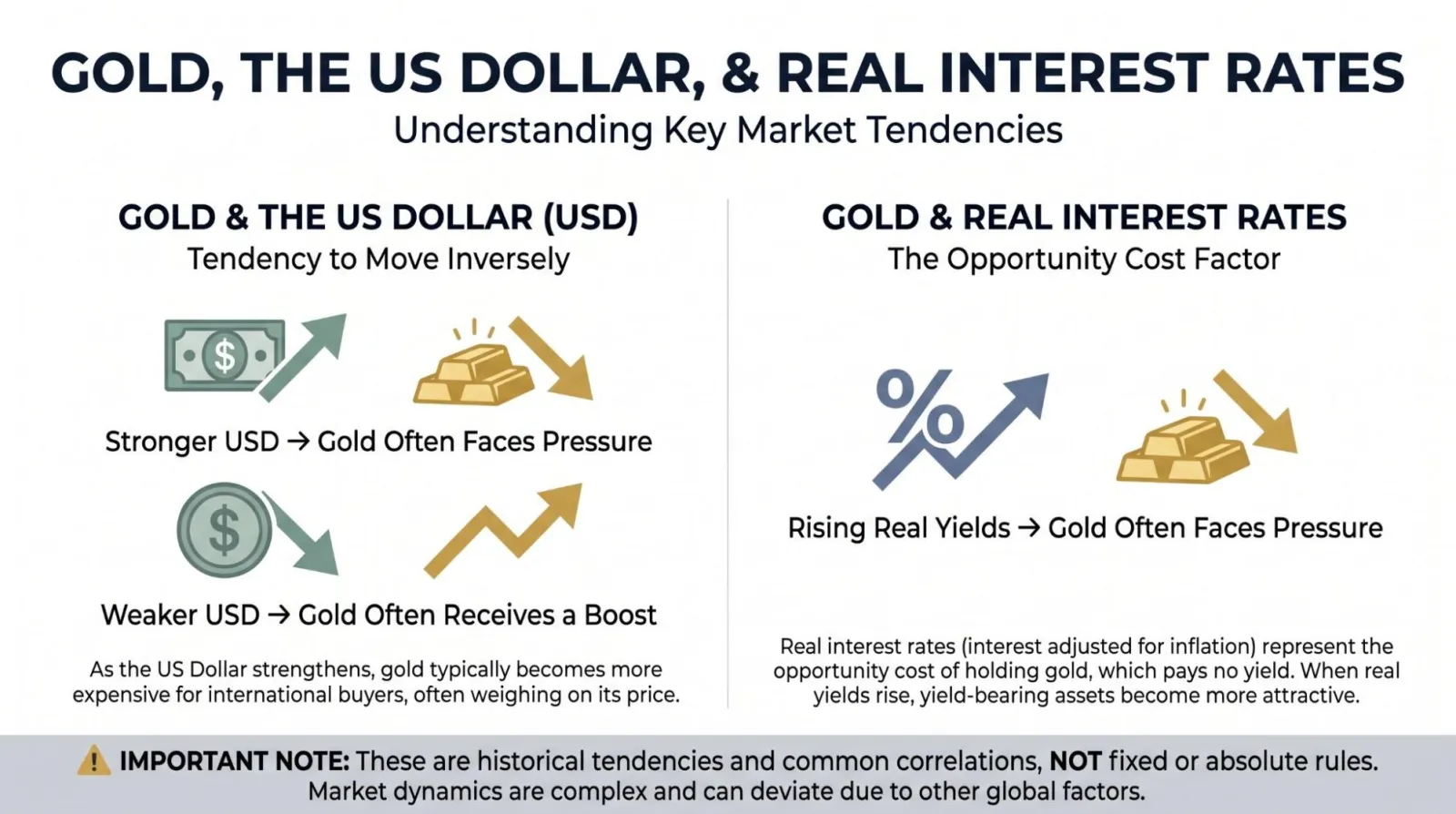
One common observation is that gold and the US dollar often move in opposite directions. When the dollar strengthens, gold may come under pressure. When the dollar weakens, gold may find support.
However, this relationship is not a fixed rule. Gold and the dollar can move in the same direction, and either market can respond to factors that have little to do with the other.
Understanding the connection helps traders interpret market movements more carefully. Rather than assuming that a rising dollar automatically means falling gold prices, it is more useful to understand the forces influencing both markets.
Why Are Gold and the US Dollar Connected?
The relationship begins with how gold is priced. Gold is commonly quoted internationally in US dollars per troy ounce. In the forex market, the gold-dollar pair is represented by XAU/USD, where XAU represents gold and USD represents the US dollar.
Because gold is priced in dollars, movements in the dollar can affect how expensive gold is for buyers using other currencies.
Imagine that the dollar strengthens against the euro, the British pound, and other major currencies. A buyer using one of those currencies may need to spend more of their local currency to purchase the same amount of dollar-priced gold. If other conditions remain unchanged, this can reduce demand and put downward pressure on gold prices.
The reverse can also happen. When the dollar weakens, gold may become relatively cheaper for buyers using other currencies, potentially supporting demand.
There is another important consideration: investors compare gold with other assets. Changes in US interest-rate expectations, inflation expectations, and economic uncertainty can influence both the dollar and gold at the same time.
This is why the relationship is more complicated than a simple currency conversion effect. The dollar is one influence on gold prices, not the only one.
What Happens When the US Dollar Strengthens?
A stronger dollar can create headwinds for gold, particularly when the strength reflects expectations of higher US interest rates or relatively attractive returns on dollar-denominated assets.
Consider a hypothetical situation in which US economic data comes in stronger than expected. Traders may conclude that the Federal Reserve is less likely to cut interest rates soon, or may expect rates to remain higher for longer.
That shift in expectations can support the dollar because investors may see US assets as relatively attractive. At the same time, higher expected real interest rates can make holding gold less appealing.
Gold does not pay interest or dividends. When investors can earn a more attractive inflation-adjusted return from certain interest-bearing assets, the opportunity cost of holding gold increases.
If the dollar strengthens and real yields rise together, gold may face pressure from both developments.
However, the outcome depends on what the market has already priced in and why the dollar is rising. A stronger dollar caused by improving US growth expectations may affect gold differently from a stronger dollar caused by a sudden global rush for liquidity.
The key point: dollar strength can weigh on gold, but traders should identify the reason for the dollar's move before drawing conclusions about gold.
What Happens When the US Dollar Weakens?
A weaker dollar can support gold through several channels.
First, dollar-priced gold becomes relatively less expensive for buyers whose home currencies have strengthened against the dollar. This may help support international demand, although the actual effect depends on local economic conditions and other factors.
Second, a weakening dollar may reflect expectations of lower US interest rates. If those expectations also contribute to falling real yields, gold may become more attractive relative to interest-bearing assets.
Third, dollar weakness can sometimes reflect concerns about US economic conditions, inflation, or fiscal uncertainty. Depending on the circumstances, those concerns may increase demand for gold as a store of value or portfolio diversifier.
For example, suppose markets begin expecting the Federal Reserve to cut rates because inflation is easing and economic growth is slowing. The dollar could weaken as investors adjust their expectations for US interest rates. If real yields also fall, gold could receive additional support.
But the result is not guaranteed. If investors are reducing gold holdings, central-bank demand changes, or other major currencies are weakening even faster, gold may fail to rise despite a softer dollar.
A falling dollar is therefore a useful piece of information—not a standalone buy signal for gold.
The Role of Interest Rates and Real Yields
To understand gold and the dollar more fully, traders need to look beyond the Federal Reserve's headline interest rate and consider real yields. (For the wider picture, see how interest rates affect stocks, forex, and gold.)
A real yield is an interest rate adjusted for expected inflation. In simplified terms, it helps investors assess the purchasing-power return available from an interest-bearing asset.
Real yields matter because gold does not generate a regular income. When real yields rise, investors may have a stronger incentive to hold assets that offer an inflation-adjusted return. All else being equal, this can reduce gold's relative appeal.
When real yields fall, the opportunity cost of holding gold may decline, potentially supporting its price.
Research published by the Federal Reserve Bank of Chicago identifies real interest rates, inflation expectations, and pessimism about future economic conditions as important factors in understanding gold prices. The research also shows that these relationships vary across periods rather than working identically in every market environment.
The dollar and real yields are connected, too. Expectations about US monetary policy can influence Treasury yields and the relative attractiveness of dollar-denominated investments. But the dollar also responds to developments in other countries, global risk sentiment, and currency-market positioning.
This creates several possible scenarios:
- Dollar stronger, real yields higher: gold may face pressure from both a stronger currency and a higher opportunity cost.
- Dollar weaker, real yields lower: gold may receive support from both developments.
- Dollar stronger, real yields lower: the two influences may pull gold in different directions.
- Dollar weaker, real yields higher: gold may also face conflicting signals.
These are frameworks for interpreting market conditions, not predictions. Gold can still move against the expected direction when other forces dominate.
Why Gold and the Dollar Sometimes Rise Together
One of the most important mistakes traders can make is assuming gold and the dollar must always move in opposite directions.
Both can rise when investors respond to a major geopolitical event, financial shock, or sudden increase in uncertainty. The dollar may attract demand because of its role in global payments and financial markets, while gold may attract buyers seeking diversification or protection against particular risks.
The two assets can also respond differently to the same event.
For example, a geopolitical shock might initially strengthen the dollar as investors seek liquidity. Gold might rise as well if demand for perceived safe-haven assets increases. Alternatively, gold could fall if the dollar surges sharply, real yields rise, or investors sell assets to raise cash.
The result depends on the nature of the event, the market's starting position, and how investors interpret the implications for inflation, interest rates, and economic growth.
Gold also has drivers that are not directly tied to the dollar. These include central-bank purchases, investment flows, jewellery demand, supply conditions, and changes in investor positioning. The World Gold Council's analysis of gold-price drivers groups the main influences into economic expansion, risk and uncertainty, opportunity cost, and momentum. It also notes that the dollar and US rates are important without being the only determinants of gold's direction.
The lesson is simple: when gold and the dollar rise together, it does not necessarily mean their usual relationship has broken permanently. It may mean that other forces are temporarily more influential.
How Traders Can Analyse Gold and the Dollar Together
Traders can use the dollar as part of their gold-market analysis, but it helps to combine it with other information.
1. Watch the US Dollar Index
The US Dollar Index (DXY) measures the dollar against a basket of major currencies. It is often used as a broad gauge of dollar strength or weakness.
If DXY is rising while XAU/USD is falling, the move may fit the commonly observed inverse relationship. If both are rising, traders should consider whether gold is responding to another factor, such as safe-haven demand or central-bank buying.
DXY is not a direct measure of every currency or of the dollar's value against all global trading partners. It should be treated as one indicator, not a complete picture of dollar conditions.
2. Check Treasury Yields and Inflation Expectations
US Treasury yields can help explain changes in the relative appeal of gold. Real yields are especially relevant because they account for inflation expectations.
A rise in real yields may help explain why gold is struggling even if the dollar is not moving much. Likewise, falling real yields may help gold hold firm despite temporary dollar strength.
Traders should avoid interpreting a change in nominal yields in isolation. Nominal yields can rise because inflation expectations are increasing, because expected real returns are increasing, or because both are changing.
3. Understand the Economic News Behind the Move
Economic releases such as inflation reports, employment figures, and Federal Reserve announcements can influence the dollar, yields, and gold.
Instead of reacting only to whether a figure is higher or lower than expected, consider how it changes the market's outlook for monetary policy and economic conditions.
A stronger-than-expected economic report, for instance, may support the dollar if traders revise their interest-rate expectations upward. But the gold response can still depend on inflation concerns, risk sentiment, and whether the outcome was already anticipated.
4. Confirm the Idea With Price Action
Macroeconomic context can help explain a possible move, but it does not replace analysis of the market itself.
Traders may examine support and resistance, trend structure, volatility, and the way prices respond after major news. A dollar-based idea becomes more useful when it aligns with the behaviour of XAU/USD rather than relying on an assumed correlation alone.
No single indicator can guarantee a correct interpretation, and market conditions can change quickly.
Common Mistakes When Trading Gold Against the Dollar
Several mistakes can lead traders to misread the relationship.
- Assuming correlation means causation: Gold and the dollar may move in opposite directions, but that does not prove that a change in the dollar caused every movement in gold. Both may be reacting to interest rates, economic data, or another underlying factor.
- Treating the relationship as permanent: Correlations change across different periods and market conditions. A pattern observed over several weeks may not remain reliable over the next several months.
- Ignoring real yields: The dollar may appear to explain a gold move when changing real yields or interest-rate expectations are also important.
- Reacting to headlines without context: A news event can affect several markets at once, sometimes in conflicting ways. The initial reaction may also reverse as traders reassess the implications.
- Using the dollar as a complete trading strategy: A view that the dollar is likely to weaken does not, by itself, establish when to buy gold, where to place a stop-loss, or how much risk to take. Trade planning requires separate decisions about entry, invalidation, position size, and the trader's risk limits.
Conclusion: Use the Relationship as Context, Not a Rule
Gold and the US dollar often move in opposite directions because gold is priced in dollars and because changes in currency strength, interest rates, and real yields can affect gold's relative appeal. However, this relationship is not consistent enough to serve as a standalone trading signal.
Gold has its own sources of demand, including central-bank purchases, investment flows, uncertainty, and physical consumption. The dollar, meanwhile, responds to US economic conditions, Federal Reserve expectations, developments abroad, and global demand for liquidity.
For traders, the most useful approach is to examine the dollar alongside real yields, economic news, risk sentiment, and gold's own price action. This broader view can help explain why the market is moving without assuming that one asset must follow the other. To see how stocks fit into the same picture, read how the S&P 500, US dollar and gold move together.
Build a bot from your idea
Describe your trading idea and the AI writes MT4 or MT5 code for you to review and test, with a plain-English explanation and setup steps. Your first bot is free.