All posts · Macro · Gold · Forex
How Interest Rates Affect Stocks, Forex, and Gold
Learn how interest rates influence stock prices, currency pairs, and gold, and why central bank decisions can affect each market differently.
· 11 min read
Interest rates are among the most important factors influencing financial markets. When central banks change their monetary policies, the effects can spread across stock prices, currency exchange rates, bond yields, and commodities such as gold.
For traders, understanding these connections can provide useful context when analysing the markets. A change in interest-rate expectations may influence how investors value companies, which currencies they prefer to hold, and whether gold becomes more attractive relative to interest-bearing assets.
However, the relationship is not always straightforward. Higher interest rates can put pressure on stocks and gold while supporting a currency, but the outcome depends on why rates are changing, what the market expected, and how investors interpret the decision.
This guide explains how interest rates work, how they affect stocks, forex, and gold, and how traders can use interest-rate information as part of a broader market-analysis process.
What Are Interest Rates, and Why Do They Matter?
An interest rate is the cost of borrowing money or the return earned by lending or depositing it. Interest rates influence decisions made by consumers, businesses, banks, and investors.
Central banks use monetary policy to influence financial conditions and help achieve objectives such as price stability and, in some economies, maximum employment. One of their main tools is the policy interest rate, which influences other borrowing and lending rates throughout the economy.
For example, the US Federal Reserve sets a target range for the federal funds rate. Changes in that target can influence short-term market rates, broader financial conditions, and expectations about the future path of monetary policy. These changes can affect spending, investment, asset prices, and the dollar.
When inflation is too high, a central bank may raise rates to make borrowing more expensive and help moderate demand. When economic activity is weak or inflation is too low, it may lower rates to support spending and investment.
These are general policy responses, not automatic rules. Central banks consider a range of economic indicators, and their decisions can differ depending on the circumstances.
Markets also respond to expectations. If investors already anticipate a rate increase, the announcement may have little additional effect. An unexpected decision—or a change in the central bank's outlook—can produce a much stronger reaction.
How Interest Rates Affect the Stock Market
Interest rates influence stocks through several channels, including company borrowing costs, consumer spending, corporate earnings, and the way investors value future profits.
1. Higher Rates Can Put Pressure on Stock Prices
When interest rates rise, businesses may face higher borrowing costs. Companies that rely on debt to finance expansion, manage cash flow, or refinance existing loans can become more sensitive to those costs.
Consumers may also reduce spending if mortgage payments, credit-card costs, and other borrowing expenses increase. If businesses experience weaker demand, their revenue and profit expectations may deteriorate.
Higher interest rates can also affect stock valuations. Investors generally value companies by considering their expected future cash flows and the rate used to discount those cash flows to today's value. When the relevant discount rate rises, the present value of future earnings can fall, all else being equal.
This effect can be especially important for growth companies whose valuations depend heavily on profits expected far into the future.
However, not every stock responds in the same way. Banks, insurers, commodity producers, and companies with strong cash flows may react differently from highly leveraged businesses or companies whose valuations depend on distant future growth.
2. Lower Rates Can Support Stocks
When interest rates fall, borrowing may become cheaper for businesses and consumers. Lower financing costs can support investment, spending, and corporate earnings.
Lower rates can also make bonds and cash-like investments less attractive relative to stocks, potentially encouraging investors to seek higher returns in the equity market.
In addition, a lower discount rate can increase the present value of expected future earnings, supporting valuations.
But a rate cut does not automatically make stocks rise. Central banks may cut rates because the economy is weakening or a recession risk is increasing. If investors expect falling earnings or greater financial stress, stock prices may decline despite cheaper borrowing.
What matters is not just whether rates rise or fall, but why they are changing and how the decision compares with market expectations.
How Interest Rates Affect the Forex Market
Interest rates are particularly important in forex because currencies are traded relative to one another. A currency's attractiveness can depend partly on the interest rates available in its economy compared with those available elsewhere.
1. Interest-Rate Differentials Influence Currency Demand
Suppose the Federal Reserve is expected to maintain relatively high interest rates while the European Central Bank is expected to lower rates.
If other conditions remain comparable, dollar-denominated assets may offer more attractive yields than euro-denominated alternatives. This can encourage demand for the dollar and influence EUR/USD, which measures the value of the euro against the US dollar.
In general, expectations of relatively higher interest rates can support a currency, while expectations of relatively lower rates can weigh on it.
However, this is not a guaranteed relationship. Investors also consider inflation, economic growth, political risks, fiscal conditions, liquidity, and the expected future path of rates. A currency may weaken even when its central bank raises rates if the decision is less hawkish than the market anticipated.
2. Central-Bank Announcements Can Trigger Volatility
Forex markets often react not only to rate decisions but also to central-bank statements, press conferences, and economic projections.
Imagine that a central bank leaves rates unchanged, as most traders expected, but signals that rates may remain higher for longer. The currency could strengthen because investors revise their expectations about future returns.
Alternatively, the currency could weaken if policymakers indicate that rate cuts may arrive sooner than previously anticipated.
This is why traders pay attention to the full announcement rather than focusing only on the headline decision.
3. Rate Changes Can Affect Both Sides of a Currency Pair
A currency pair always compares two currencies. If the dollar strengthens, EUR/USD may fall—but the pair's movement also depends on what happens to the euro.
For example, the dollar might weaken after a change in US interest-rate expectations, yet EUR/USD could still fall if new European economic data causes the euro to weaken even more.
Traders therefore need to compare the economic outlook and monetary-policy expectations for both currencies instead of analysing one central bank in isolation.
How Interest Rates Affect Gold
Gold differs from stocks and currencies because it does not pay interest or dividends. Its price can therefore be sensitive to the returns investors can earn from competing assets.
One important concept is the real interest rate, which is an interest rate adjusted for inflation. In simplified terms, real rates help investors assess the inflation-adjusted return available from an interest-bearing asset.
1. Higher Real Rates Can Weigh on Gold
When real yields rise, interest-bearing assets may become more attractive relative to gold. The opportunity cost of holding gold increases because investors forgo the interest they might earn elsewhere.
For example, if US Treasury inflation-protected securities offer higher real yields, some investors may become less willing to hold gold, all else being equal. This can create downward pressure on gold prices.
The World Gold Council identifies the opportunity cost of holding gold—including interest rates and competing assets—as one of the important factors influencing gold demand.
2. Lower Real Rates Can Support Gold
When real yields fall, the return sacrificed by holding gold may become smaller. This can make gold more attractive to some investors.
Lower real yields may occur when nominal interest rates fall, when inflation expectations rise relative to nominal yields, or through a combination of both.
Gold may also benefit if lower interest-rate expectations weaken the US dollar, making dollar-priced gold relatively cheaper for buyers using other currencies. (More on that link in gold vs. the US dollar.)
However, neither lower rates nor a weaker dollar guarantees higher gold prices. Central-bank purchases, geopolitical risks, investor positioning, and other sources of demand can change the outcome.
3. Why Gold Can Rise Even When Rates Increase
It is tempting to assume that gold must fall whenever central banks raise interest rates. In practice, the relationship is more complicated.
Rates may rise because the economy is strengthening, because inflation is proving persistent, or because investors are demanding higher compensation for holding government debt. Each situation can have different implications for gold.
If a rate increase is accompanied by greater financial uncertainty or strong central-bank gold purchases, those forces may offset the pressure from higher yields.
For traders, the important distinction is between a simple rate change and the broader economic conditions behind it.
Comparing the Effects Across Stocks, Forex, and Gold
The following table summarises common tendencies. These are general frameworks, not rules that apply in every market environment.
| Market | When rates rise or are expected to rise | When rates fall or are expected to fall |
|---|---|---|
| Stocks | Higher borrowing costs and discount rates may pressure valuations, though stronger growth can offset this | Cheaper borrowing and lower discount rates may support valuations, unless rate cuts signal economic weakness |
| Forex | A currency may strengthen if its expected returns rise relative to those of other currencies | A currency may weaken if its expected returns fall relative to those of other currencies |
| Gold | Higher real yields can increase the opportunity cost of holding gold | Lower real yields can reduce the opportunity cost of holding gold |
These reactions depend on market expectations, inflation, economic growth, and other factors. A rate change can affect all three markets, but it does not affect them through identical mechanisms.
A Practical Example: One Rate Decision, Three Market Reactions
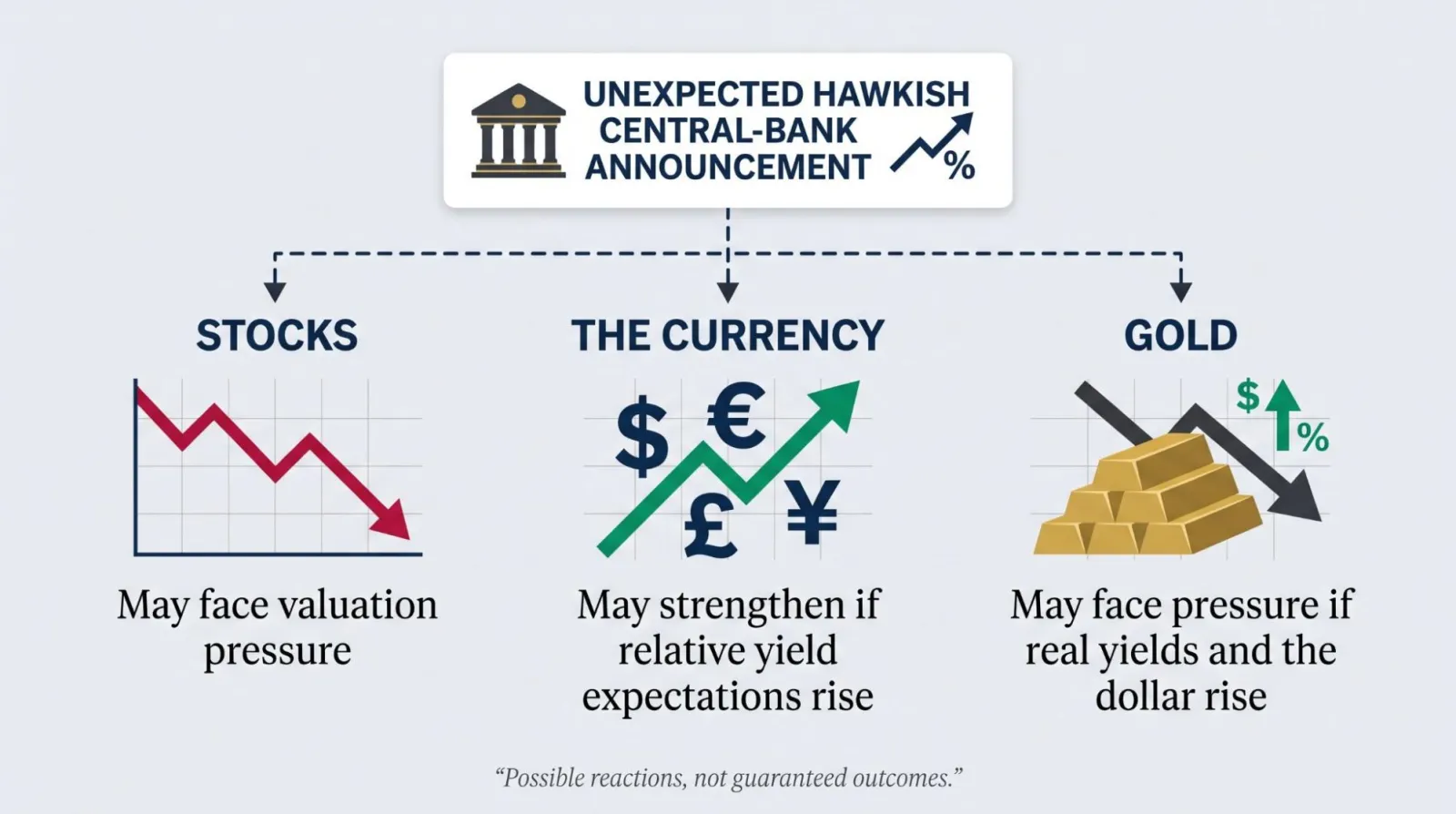
Imagine that the Federal Reserve unexpectedly signals that US interest rates will remain higher for longer because inflation is proving difficult to control.
The initial market reaction might unfold as follows:
Stocks: Some shares could come under pressure as investors reassess borrowing costs and the discount rate applied to future earnings. Companies with high financing needs or valuations dependent on distant future profits may be particularly sensitive.
Forex: The dollar could strengthen if investors revise US interest-rate expectations upward relative to those of other economies. However, the reaction will also depend on how foreign central banks and currencies respond.
Gold: Gold could face pressure if the announcement pushes real yields higher and supports the dollar. But if investors interpret the news as a warning about persistent inflation or financial instability, demand for gold could offset some of that pressure.
Now consider the opposite situation: inflation is easing, and the Federal Reserve signals that rate cuts may be appropriate.
Stocks might benefit from lower expected financing costs and discount rates. The dollar could weaken if its expected yield advantage narrows. Gold might gain support if real yields decline.
Yet the outcomes remain conditional. If the rate-cut outlook reflects a severe deterioration in economic growth, stocks could fall even as rates decline. If foreign central banks are easing more aggressively, the dollar may not weaken. Gold could also respond to factors unrelated to monetary policy.
The example shows why traders should interpret interest-rate decisions as part of a broader economic story rather than treating them as automatic buy or sell signals.
How Traders Can Use Interest-Rate Information
Interest-rate analysis can help traders build context around a potential opportunity. A structured process can make that analysis more useful.
1. Follow the Economic Calendar
Monitor major inflation reports, employment data, central-bank meetings, and other releases that may influence interest-rate expectations.
The actual figure is only part of the story. Compare it with the consensus forecast and consider whether it changes expectations for future monetary policy.
2. Watch Expectations, Not Just the Current Policy Rate
Markets often move before a central bank changes its official rate. Investors may adjust bond yields, currencies, stocks, and gold prices as expectations evolve.
Pay attention to central-bank guidance and market-implied expectations, while remembering that neither guarantees what policymakers will do.
3. Monitor Yields and Currency Movements
For gold, real yields can help explain changes in the opportunity cost of holding the metal. For forex, compare expected interest rates and monetary policy across both currencies in the pair. For stocks, consider how changes in yields may affect financing costs and valuations.
These indicators can provide context, but none should be treated as a complete trading signal.
4. Confirm With Price Action and Manage Risk
After assessing the macroeconomic backdrop, examine the market you intend to trade. Look at the prevailing trend, important price levels, volatility, and whether the setup fits your trading plan.
Decide in advance where the trade idea would be invalidated and how much you are prepared to risk. Interest-rate analysis can help explain market conditions, but it cannot guarantee the timing or direction of the next price move.
Common Mistakes to Avoid
Assuming every rate hike strengthens a currency: A rate increase may already be priced in, or the central bank may sound less hawkish than expected.
Assuming rate cuts always lift stocks: Lower rates may support valuations, but concerns about recession or falling corporate earnings can outweigh that benefit.
Ignoring real yields when analysing gold: Nominal interest rates alone do not fully explain the opportunity cost of holding gold.
Treating economic news as a guaranteed signal: Market reactions depend on expectations, positioning, and the broader economic context.
Ignoring other central banks: Forex is relative. A currency's performance depends on developments affecting both sides of the pair.
Overlooking risk management: Even a well-researched view can be wrong, particularly when markets respond unpredictably to new information.
Conclusion: Understand the Reason Behind the Rate Change
Interest rates connect the stock market, forex, and gold through borrowing costs, asset valuations, currency demand, and the opportunity cost of holding different assets.
Higher rates can pressure some stocks, support a currency when its expected returns improve relative to others, and weigh on gold when real yields rise. Lower rates can have the opposite effects, but economic weakness, inflation expectations, and changing investor sentiment can produce very different outcomes.
For traders, the most useful approach is to ask why interest rates are changing, whether the decision was expected, and how it affects the broader economic outlook. Combining that understanding with price analysis and disciplined risk management provides a more balanced framework than trading rate decisions in isolation.
To see how these three markets interact day to day, read how the S&P 500, US dollar and gold move together.
Build a bot from your idea
Describe your trading idea and the AI writes MT4 or MT5 code for you to review and test, with a plain-English explanation and setup steps. Your first bot is free.