All posts · Macro · Gold · Market analysis
How the S&P 500, US Dollar and Gold Move Together
Learn how the S&P 500, US dollar and gold interact, what drives their movements, and how traders can use these relationships in market analysis.
· 9 min read
The S&P 500, US dollar and gold can tell traders different things about the financial markets. The S&P 500 reflects the performance of 500 leading publicly traded US companies, the US dollar is a major global currency, and gold is both a widely traded commodity and an asset that investors may use to diversify their portfolios.
Watching these markets together can help traders understand how investors are responding to economic growth, interest rates, inflation, and uncertainty. For example, rising stock prices alongside a weaker dollar may reflect improving risk appetite, while falling stocks and rising gold may indicate growing demand for assets perceived as defensive.
But these relationships are not fixed. Stocks, the dollar, and gold can rise or fall together, depending on what is driving the market.
Understanding the connections between them is the foundation of intermarket analysis: examining multiple related markets to build a broader picture of financial conditions rather than analysing each chart in isolation.
What Do the S&P 500, US Dollar and Gold Tell Traders?
Before comparing their movements, it helps to understand what each market represents and which factors influence it.
The S&P 500: A View of the US Stock Market
The S&P 500 is a stock market index tracking approximately 500 leading US companies. It is commonly used as a broad indicator of the US equity market, although its performance is influenced heavily by its largest constituents and does not represent every company or sector equally.
The index can rise when investors expect stronger corporate earnings, economic growth, or more favourable financial conditions. It can fall when earnings expectations deteriorate, interest rates rise unexpectedly, or investors become less willing to hold risky assets.
Interest rates matter because they affect borrowing costs, company valuations, and the discount rate investors use to value future earnings. (See how interest rates affect stocks, forex, and gold.)
The US Dollar: Currency Strength and Global Demand
The US dollar is the world's leading reserve currency and plays a major role in international trade and financial markets.
Traders often monitor the US Dollar Index (DXY), which measures the dollar against a basket of major currencies. A rising DXY generally indicates that the dollar is strengthening against that basket, while a falling DXY indicates relative weakness.
Dollar movements can reflect expectations about US interest rates, economic performance, monetary policy in other countries, and demand for liquidity during periods of uncertainty.
Importantly, a stronger dollar does not necessarily mean the US economy is performing well. The currency can also strengthen when investors seek liquidity or when conditions outside the United States weaken.
Gold: More Than a Reaction to the Dollar
Gold is commonly quoted in US dollars per troy ounce. Its price responds to a range of factors, including real interest rates, dollar movements, central-bank demand, investment flows, and geopolitical or financial uncertainty.
Because gold does not pay interest or dividends, the returns available from other assets can influence its relative appeal. Lower real yields may make gold more attractive, all else being equal, while higher real yields can increase the opportunity cost of holding it.
Gold is sometimes described as a safe-haven asset, but this does not mean its price always rises during market declines. Its behaviour depends on the type of shock affecting the market and how investors respond. For a closer look, see gold vs. the US dollar.
How the S&P 500, US Dollar and Gold Interact
The relationships between these markets become easier to understand when viewed through a few common economic scenarios.
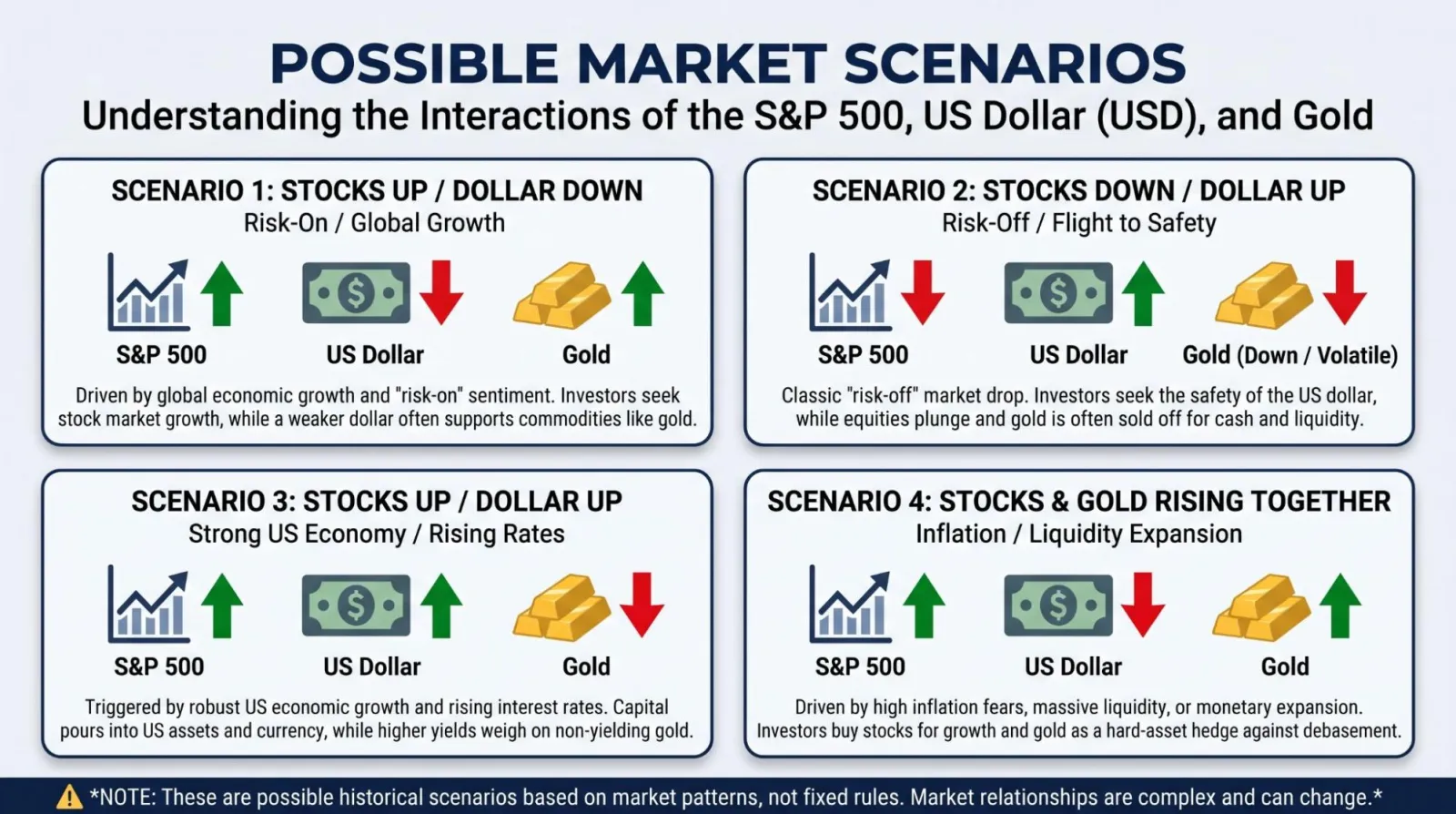
1. When Stocks Rise and the Dollar Weakens
A rising S&P 500 alongside a weakening dollar can occur when investors become more optimistic about global growth and more willing to take risks.
For example, markets may respond positively to improving economic data, stronger corporate earnings, or expectations of easier US monetary policy. Investors may move towards equities and other growth-sensitive assets, while the dollar loses some of its relative appeal.
Gold's response is less straightforward. If the weaker dollar is accompanied by falling real yields, gold may receive support. However, if optimism reduces demand for defensive assets, gold could struggle even as the dollar falls.
This scenario can suggest improving risk appetite, but traders should still examine what is driving the move rather than assuming all three markets will respond in a particular way.
2. When Stocks Fall and the Dollar Strengthens
A falling S&P 500 alongside a rising dollar can occur during periods of market stress.
Suppose disappointing economic data raises concerns about corporate earnings or the outlook for global growth. Investors may reduce exposure to equities, while demand for the dollar increases because of its liquidity and role in global financial transactions.
This pattern has appeared during some historical episodes of financial stress. However, the dollar is not guaranteed to strengthen whenever stocks fall. If the source of uncertainty centres on US policy or confidence in US assets, the dollar can weaken instead.
Gold may rise if investors seek diversification or protection against financial uncertainty. It may also fall if real yields increase or investors sell liquid assets to raise cash.
3. When Stocks Rise and the Dollar Strengthens
A rising S&P 500 and a stronger dollar can occur together when US economic performance looks more attractive relative to other economies.
Stronger US growth expectations may support corporate earnings and equities while also encouraging investors to favour dollar-denominated assets. If markets expect US interest rates to remain relatively high, that may provide additional support for the currency.
Gold's reaction depends on the accompanying changes in yields, inflation expectations, and demand for defensive assets. Rising real yields may weigh on gold, but concerns about inflation or financial stability can offset that pressure.
This combination illustrates why traders should not interpret the dollar's direction as a simple measure of whether investors are optimistic or pessimistic.
4. When Stocks and Gold Rise Together
Gold and stocks can rise at the same time, particularly when economic conditions support corporate earnings while also encouraging demand for gold.
For example, investors may be optimistic about growth but remain concerned about inflation, geopolitical risks, or the long-term purchasing power of currencies. In that environment, they may hold equities for potential growth and gold for diversification.
The World Gold Council has highlighted that gold's relationship with US equities changes across market environments. Gold can have a positive relationship with stocks during periods of economic growth and a more defensive relationship during some risk-off episodes.
The practical lesson is that gold should not automatically be treated as the opposite of the stock market. The underlying economic conditions matter more than a simple assumption about correlation.
The Role of Interest Rates, Inflation and Economic Growth
Interest rates are one of the important links connecting stocks, the dollar, and gold.
When markets expect the Federal Reserve to raise rates or keep them higher for longer, several effects may occur. Higher borrowing costs can put pressure on some companies and equity valuations. Higher expected returns on dollar-denominated assets can support the dollar. Rising real yields can also make gold less attractive relative to interest-bearing assets.
But the effects are not automatic. Strong economic growth can support company earnings even when interest rates rise, and the dollar can weaken if investors expect other central banks to tighten policy more aggressively.
Inflation adds another layer of complexity. Unexpectedly high inflation may increase expectations of higher interest rates, putting pressure on stocks and gold while supporting the dollar in some circumstances. Alternatively, concerns that inflation will erode purchasing power may increase demand for gold.
The source of the inflation matters. Inflation driven by strong demand can affect markets differently from inflation caused by a supply shock, such as a sharp rise in energy costs.
Economic growth also influences all three markets. Stronger growth may support corporate earnings and the S&P 500, but its effects on the dollar and gold depend on interest-rate expectations and conditions elsewhere in the world.
There is no single economic indicator that reliably predicts all three markets. Traders need to assess the full context.
How Traders Can Use Intermarket Analysis
Monitoring the S&P 500, dollar, and gold together can provide useful context, but the goal is not to find a relationship that works every time. The goal is to identify the market environment and test whether the evidence supports a trading idea.
Step 1: Identify the Main Market Driver
Start by asking what is moving the markets. Is there an inflation report, a Federal Reserve announcement, an earnings development, a geopolitical event, or a change in global risk appetite?
The answer helps explain why different assets may be moving together or in opposite directions.
Step 2: Compare the Markets on Similar Timeframes
Compare price movements over consistent periods. For example, look at daily charts together if you are analysing daily trends, rather than comparing a short-term move in gold with a long-term trend in stocks.
You can monitor the S&P 500, DXY, and XAU/USD using the charting platform of your choice. Remember that DXY measures the dollar against a currency basket, while XAU/USD represents the dollar price of gold.
Step 3: Look for Confirmation and Conflicting Signals
Suppose the S&P 500 is breaking above a previous resistance level while the dollar weakens. That combination may fit a scenario of improving risk appetite.
However, if gold is also rising sharply, consider whether falling real yields, inflation concerns, or safe-haven demand could be influencing the market.
Conflicting signals are not necessarily a reason to abandon an idea. They are a reason to investigate the underlying drivers before deciding how to act.
Step 4: Confirm With the Asset You Intend to Trade
If you plan to trade gold, analyse gold's own trend, support and resistance, volatility, and potential entry and exit levels. If you plan to trade an index, focus on the index's own price structure and risk characteristics.
Intermarket analysis should support your decision-making, not replace a trading plan. It cannot tell you exactly when to enter a trade or guarantee that the expected relationship will continue.
Common Mistakes When Comparing These Markets
- Assuming correlations never change: Relationships between assets can shift as inflation, monetary policy, and investor behaviour change. A pattern that appears strong over one period may weaken in another.
- Treating the dollar as a direct measure of risk appetite: The dollar can strengthen during periods of uncertainty, but it can also rise because US interest-rate expectations improve relative to those of other countries.
- Assuming gold always rises when stocks fall: Gold may provide diversification in some conditions, but it can also decline during equity sell-offs. Liquidity needs, real yields, and the source of the shock all matter.
- Ignoring the timeframe: Two markets may move in opposite directions over several months but rise together over a few trading sessions. The chosen timeframe can change the apparent relationship.
- Confusing correlation with causation: If the S&P 500 rises while the dollar falls, that does not prove that dollar weakness caused stocks to rise. Both movements may reflect another factor, such as changes in monetary-policy expectations.
Conclusion: Read the Markets as a Group, Not a Formula
The S&P 500, US dollar, and gold provide different perspectives on the financial environment. The S&P 500 reflects expectations for US corporate performance, the dollar reflects relative currency demand and global financial conditions, and gold responds to opportunity costs, currency movements, investment demand, and uncertainty.
Sometimes their movements align with familiar patterns: stocks rise as the dollar weakens, or stocks fall while demand for the dollar and gold increases. At other times, the markets move in unexpected directions because a different force has become more important.
For traders, the best approach is to monitor these markets together, understand the economic drivers behind their movements, and confirm any trading idea using the market being traded. Intermarket analysis can provide valuable context, but it works best as one part of a broader, disciplined process.
Build a bot from your idea
Describe your trading idea and the AI writes MT4 or MT5 code for you to review and test, with a plain-English explanation and setup steps. Your first bot is free.