All posts · COT · Market analysis · Gold
What Is the COT Report? A Simple Explanation for Traders
Learn what the COT report shows, how to read trader positions, and how to use COT data to understand market sentiment.
· 8 min read
The COT report, short for the Commitments of Traders report, is a weekly publication from the U.S. Commodity Futures Trading Commission (CFTC) that shows how different groups of traders are positioned in futures markets. It helps traders understand whether certain market participants are holding more long positions, more short positions, or changing their exposure over time.
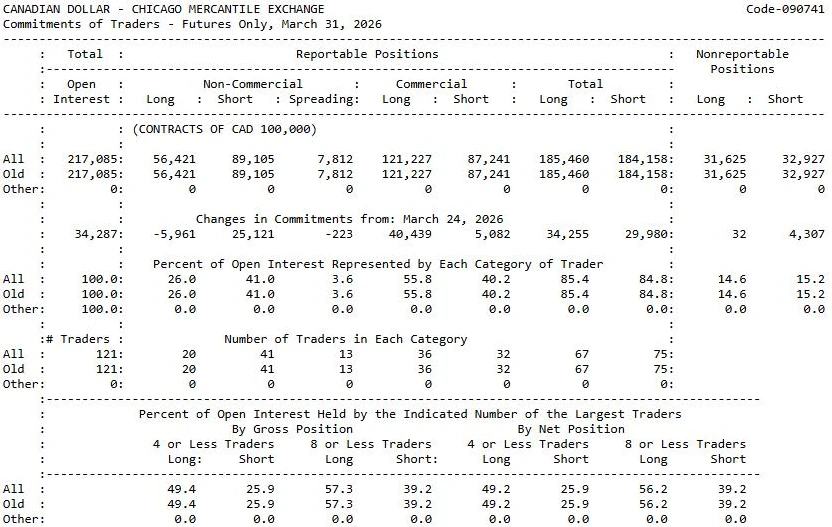
An excerpt of the CFTC's Legacy report for Canadian dollar futures, with positions as of March 31, 2026.
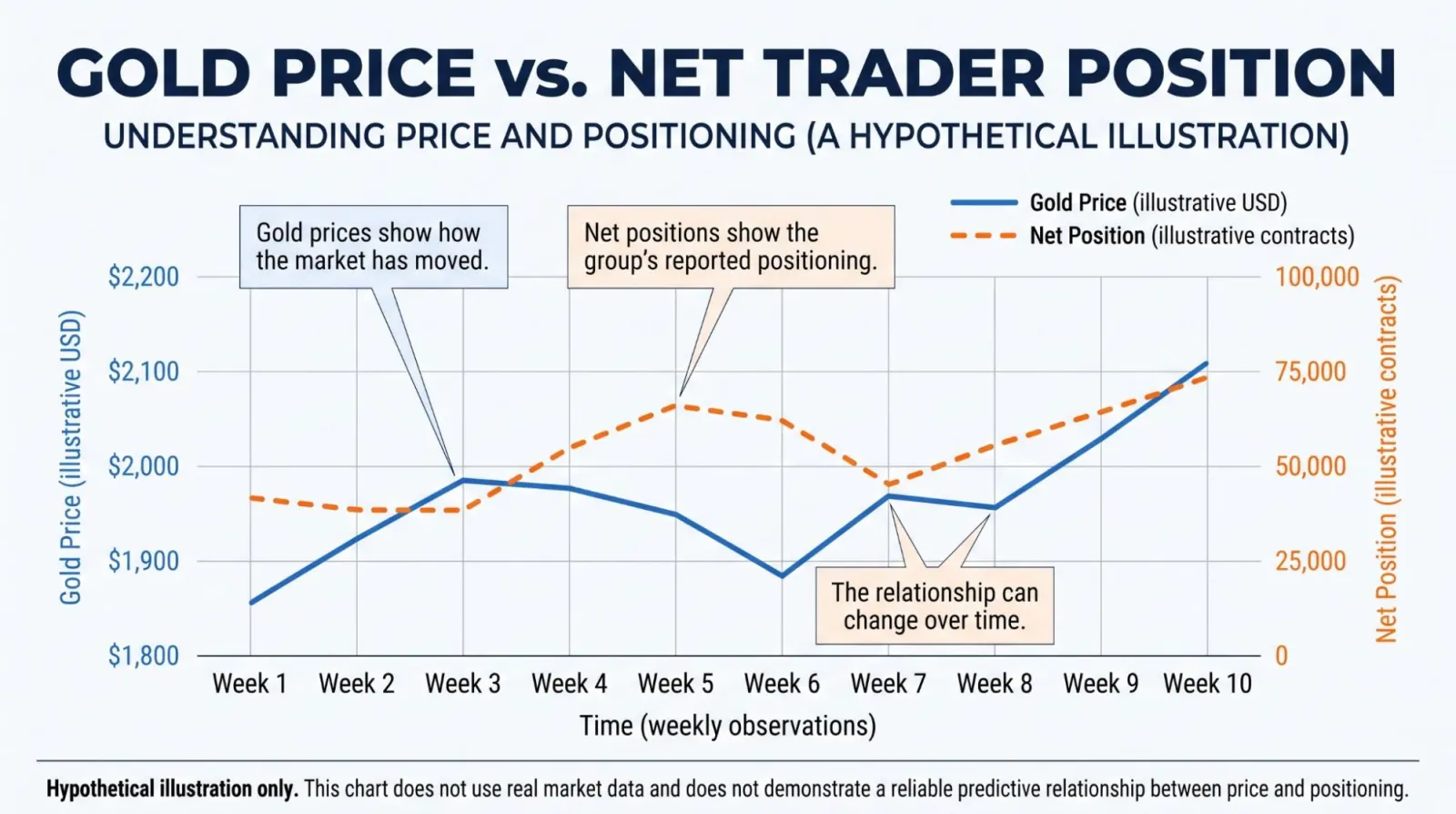
Imagine you're watching gold prices rise for several weeks. The price chart tells you what gold has done, but it doesn't tell you how different groups of futures traders are positioned behind that move. The COT report adds another piece of information by showing the balance of reported positions held by different categories of traders.
That information can help you assess market sentiment, identify unusually crowded positioning, and put price movements into context. However, the report doesn't predict what the market will do next, and it shouldn't be treated as a standalone trading signal.
How Does the COT Report Work?
The CFTC collects position information for futures and options-on-futures markets that meet its reporting requirements. It then publishes aggregated figures showing the positions held by different trader categories.
The report covers markets such as gold, crude oil, agricultural commodities, stock index futures, Treasury futures, and currency futures. The exact markets and trader categories available depend on which COT report you examine.
According to the CFTC's official explanation, the data records positions as of Tuesday and is generally published on Friday at 3:30 p.m. Eastern Time.
This delay matters. When a new report becomes available, it doesn't show every position change that has occurred up to that moment. Traders should check the report date rather than assuming the numbers reflect current market conditions.
What Do Long and Short Positions Mean?
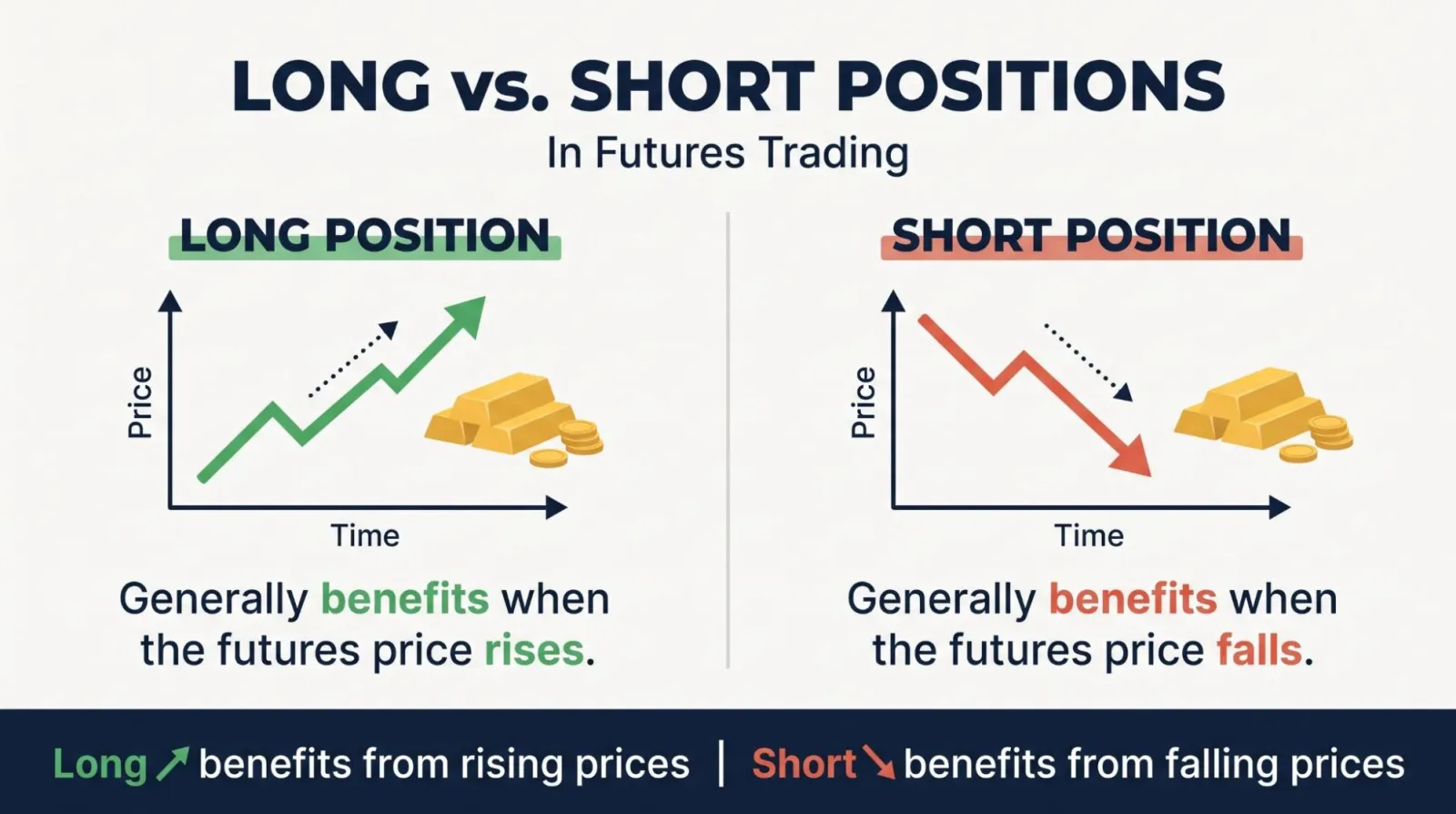
A long position represents exposure that generally benefits when the underlying futures price rises. A short position represents exposure that generally benefits when the futures price falls.
For example, suppose a group of traders holds 80,000 long gold futures contracts and 50,000 short contracts. Their net position is:
Net position = Long positions − Short positions
In this example:
80,000 − 50,000 = 30,000 net long contracts.
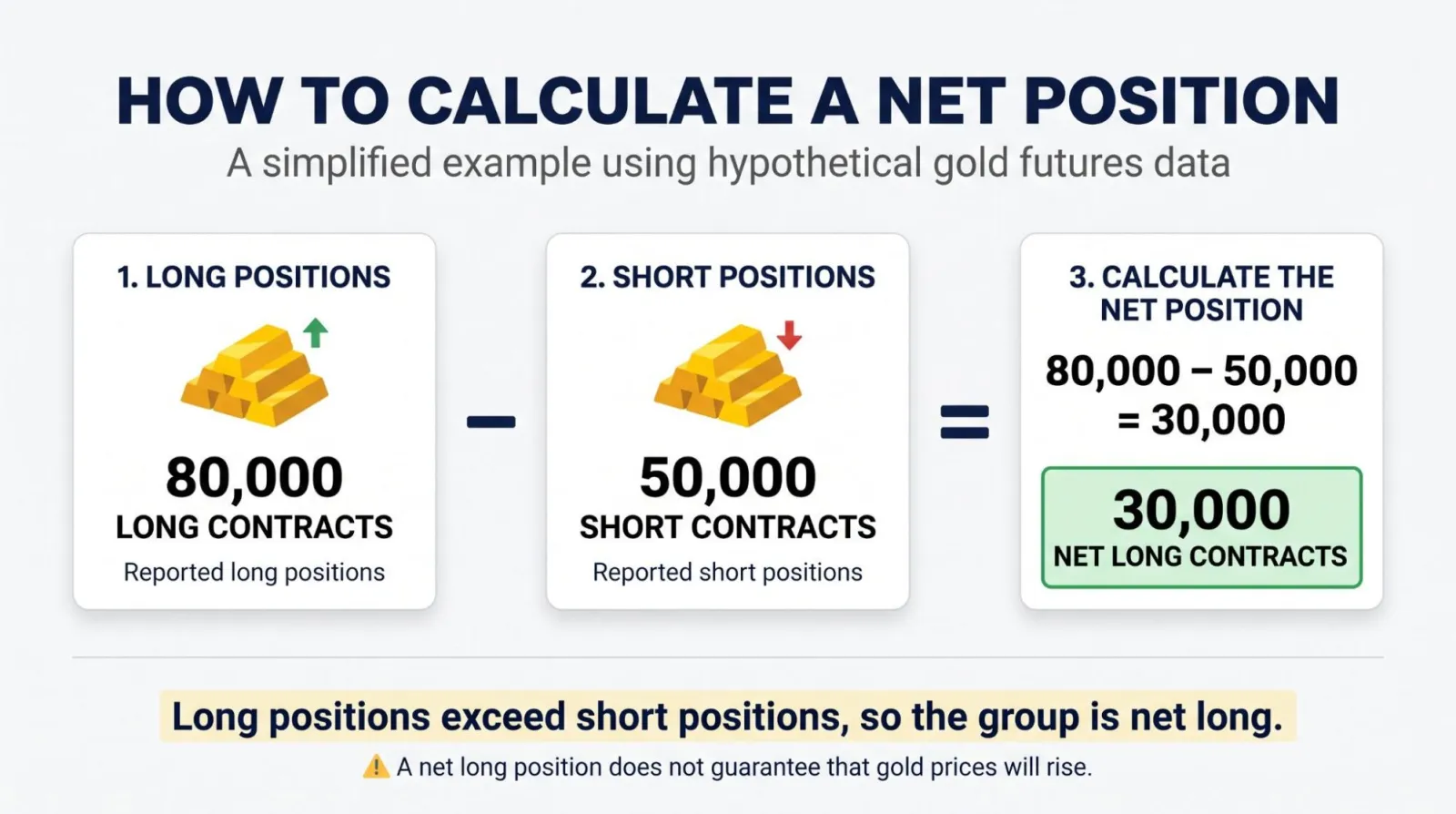
The group is net long because its reported long positions exceed its short positions. That tells you something about its positioning, but it doesn't guarantee that gold prices will rise.
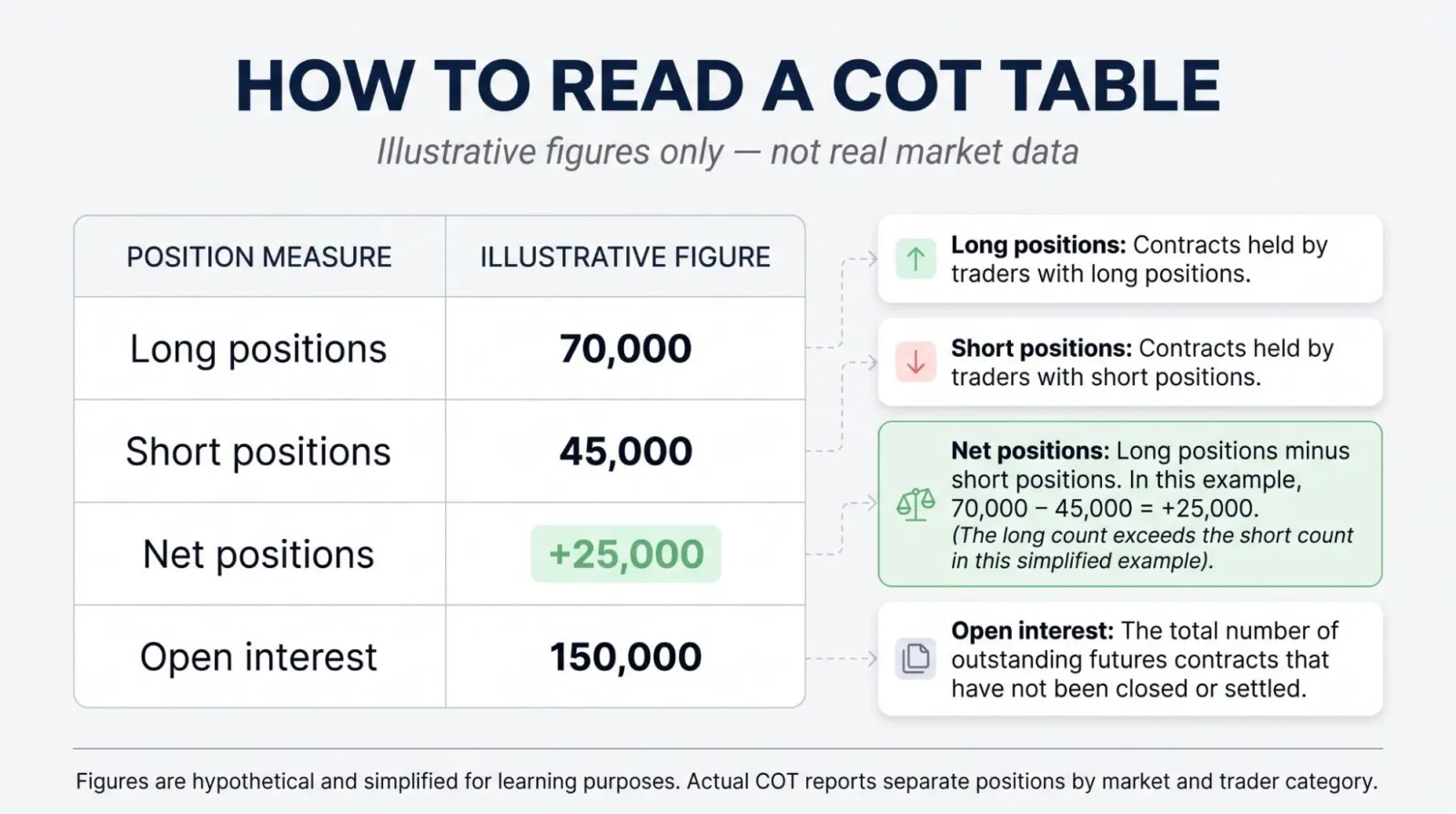
The report also includes other information, such as changes in positions from the previous week and open interest. Open interest is the number of futures contracts that remain open, rather than having been closed or settled.
Which Traders Does the COT Report Track?
One of the most important things to understand is that there isn't just one COT report format. The CFTC publishes different reports with different trader classifications.
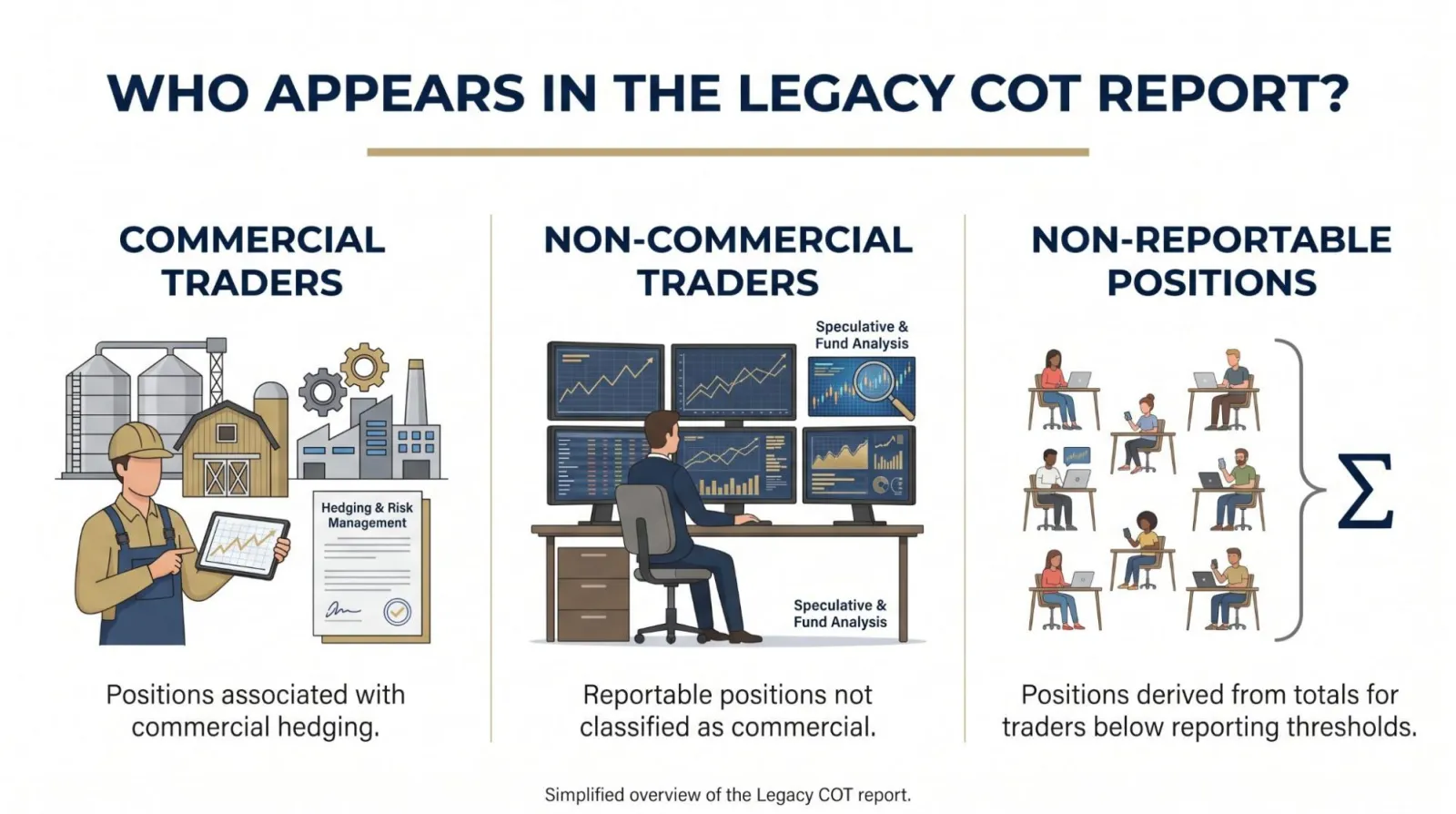
1. Commercial Traders
In the Legacy COT report, commercial traders are participants classified according to their use of futures to hedge business risks. For example, a business exposed to changes in a commodity's price may use futures to offset some of that exposure.
Commercial positioning can offer useful context, but it shouldn't automatically be interpreted as a forecast. A commercial trader may be managing business risk rather than making a directional bet on where prices will go.
2. Non-Commercial Traders
The Legacy report also identifies non-commercial traders. This broad category includes reportable participants whose positions are not classified as commercial under the report's methodology.
Many traders pay attention to this group because its positioning can provide clues about speculative sentiment. If net long positions increase over several weeks, for example, speculative exposure to rising prices may be building.
However, a larger net long position does not necessarily mean the market is about to reverse. Strong trends can continue even when positioning appears crowded.
3. Non-Reportable Positions
The Legacy report includes non-reportable positions, which are calculated as the difference between total open interest and reportable positions. These represent positions below the CFTC's reporting thresholds, but the report does not provide the same trader-level classification information for them. They're often described as small traders.
4. Other Categories in Different COT Reports
The Disaggregated report separates physical commodity market participants into categories such as producers, swap dealers, managed money, and other reportable traders.
For financial markets, the Traders in Financial Futures (TFF) report uses categories including dealers and intermediaries, asset managers, leveraged funds, and other reportable traders.
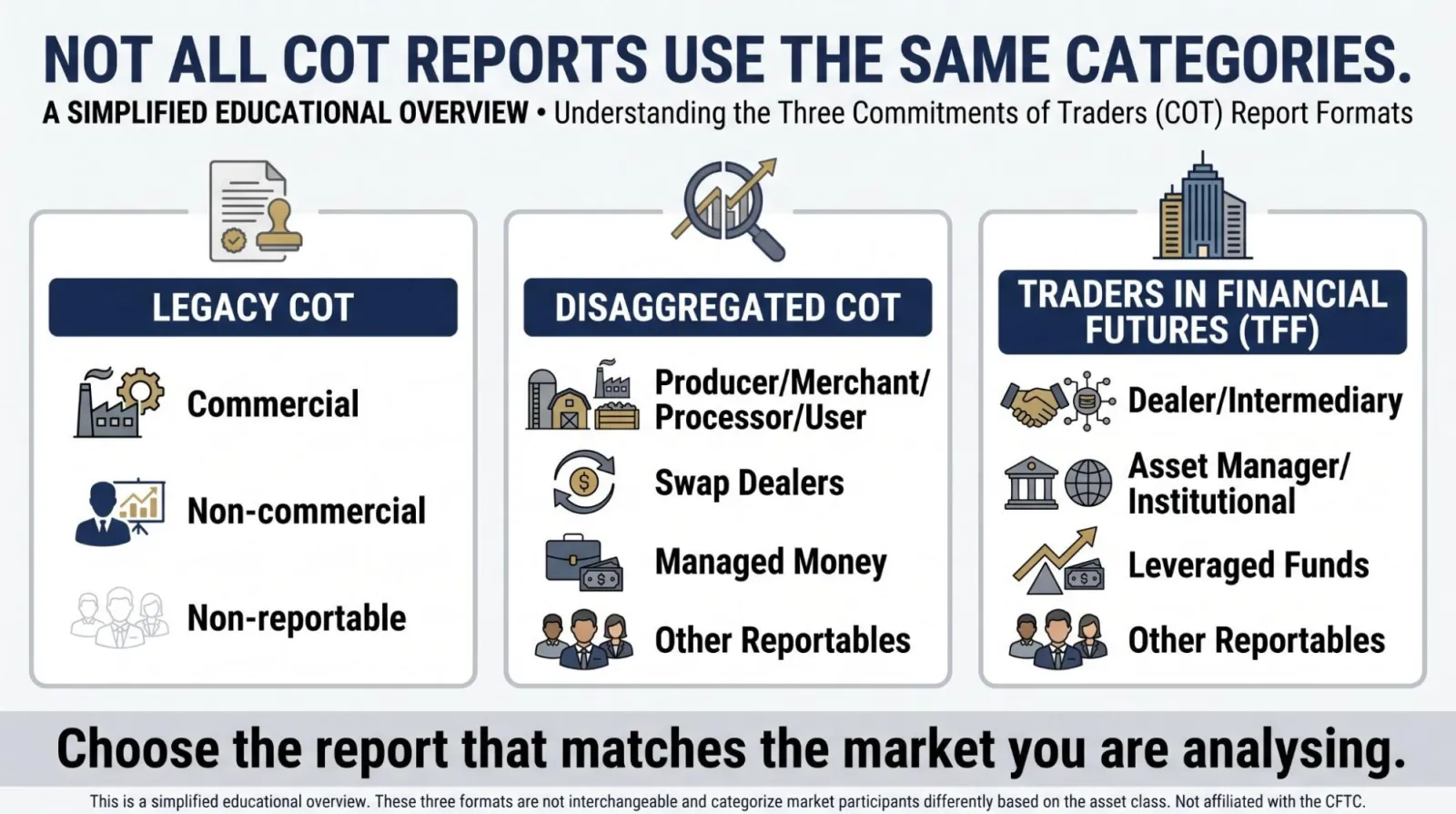
You can explore the differences in the CFTC's COT report descriptions and explanatory notes.
The key takeaway is simple: don't assume that every report uses the same categories. Choose the report that fits the market you're studying and understand what its classifications mean before interpreting the numbers.
How to Read the COT Report
You don't need to understand every column to begin using COT data. Start with a few basic steps.
Step 1: Choose the Market and Report Type
First, select the market you're interested in, such as gold futures or a currency futures contract. Then choose the appropriate COT report.
For example, someone studying speculative positioning in a financial futures market may find the TFF report useful. Someone examining a physical commodity may prefer the Disaggregated report or Legacy report, depending on the question being asked.
Step 2: Compare Long and Short Positions
Look at the long and short positions for the trader category you're studying. Calculate the net position by subtracting short contracts from long contracts.
A positive result means the group is net long. A negative result means it is net short.
But don't stop there. A net position is only one part of the picture, and the same number can mean different things in different markets.
Step 3: Check How Positions Have Changed
Compare the latest figures with previous reports.
Suppose managed money in a hypothetical market moves from 20,000 net long contracts to 35,000 net long contracts. That is an increase of 15,000 contracts in its net long position.
This could reflect growing bullish exposure. To understand the change properly, however, examine the underlying long and short figures. Net positioning can change because long positions rise, short positions fall, or both occur.
Step 4: Compare Positioning With Its Own History
A large net position isn't automatically extreme. You need to compare it with the same market's historical positioning.
For instance, 30,000 net long contracts might be unusually high for one market but relatively normal for another. Comparing a market with its own history helps prevent misleading conclusions from raw numbers alone.
Some analysts use historical ranges or a COT index to assess whether positioning is near the upper or lower end of its past range. These are analytical tools, not official forecasts, and their usefulness depends on the chosen period and methodology.
Step 5: Compare the Data With Price Action
Finally, look at what the market price is doing.
If prices and speculative positioning are both rising, that may suggest bullish participation is increasing. If prices continue rising while net long positions decline, it may indicate that positioning is changing beneath the surface.
Neither situation guarantees a particular outcome. Use the COT report to develop a market hypothesis, then assess it alongside price structure and relevant fundamental information.
How Can Forex Traders Use the COT Report?
The COT report can be useful to forex traders, but there is an important distinction: the CFTC's currency futures data is not a complete record of every position in the global spot forex market.
Currencies trade through several markets and instruments, so COT data should be understood as a view of positioning in the relevant futures contracts—not a comprehensive picture of every bank, institution, or retail trader's exposure.
A forex trader might use currency futures positioning to:
- Assess speculative sentiment: See whether a reportable trader group is becoming more net long or net short.
- Monitor crowded positioning: Identify when a group's exposure is unusually large relative to its own history.
- Add context to a fundamental view: Compare positioning with interest-rate expectations, central bank decisions, and economic developments.
- Support a broader technical analysis: Check whether positioning changes are consistent with, or diverge from, the price trend.
For example, suppose speculative positioning in a currency future becomes unusually net long while the currency continues to rise. Rather than automatically selling because positioning looks crowded, a trader could investigate whether the economic outlook still supports the move and whether price action shows any evidence of weakening.
The purpose is to ask better questions, not to force a trade from a single data point.
What Are the Limitations of the COT Report?
The COT report can add useful information to market analysis, but it has limitations.
First, the data is delayed. The normal reporting cycle means positions are recorded on Tuesday and generally published on Friday. Significant economic announcements or market moves may occur before publication.
Second, positioning is not the same as prediction. A group can remain heavily net long or net short for an extended period. An extreme reading alone doesn't tell you when a trend will end.
Third, trader classifications require context. Commercial traders may be hedging business exposure, while other categories can include participants with different strategies. It's risky to assume every position represents the same directional opinion.
Fourth, the report doesn't reveal every detail. It provides aggregated position information, not each trader's entry price, risk limits, portfolio, or reason for holding a position.
Finally, the COT report is only one source of information. It works best as part of a broader analytical process that considers price action, fundamentals, market structure, and risk.
Final Thoughts
The COT report gives traders a way to examine positioning in futures markets rather than relying on price charts alone. By understanding the report type, trader categories, net positions, and changes over time, beginners can learn to interpret the data more carefully.
Its greatest value is context. It can help you understand how participants are positioned and whether exposure is changing, but it cannot tell you with certainty what the market will do next. Used alongside price action and fundamental analysis, it can become one useful part of a disciplined market research process.
For a shorter definition, see COT in our trading guides. For how positioning fits alongside other drivers in one market, see the gold market guide.
Build a bot from your idea
Describe your trading idea and the AI writes MT4 or MT5 code for you to review and test, with a plain-English explanation and setup steps. Your first bot is free.